Google Slides Template - Medicry: A Practical Guide to Effective Medical Presentations
Creating a professional presentation in the healthcare sector requires a delicate balance between clinical accuracy and engaging design. The Google Slides Template - Medicry addresses this specific need by providing a structured, visually clean framework designed for medical professionals, health startups, and educational institutions. While many templates claim to be versatile, Medicry distinguishes itself through specialized iconography and layouts that respect the serious nature of medical content while remaining accessible to non-designers. Understanding how to leverage this tool effectively can save hours of formatting time and ensure your message is received with the professionalism it deserves.
Understanding the Scope Beyond Healthcare
A common misconception when evaluating the Introducing Medicry Medical Google Slides Template is assuming it is strictly limited to hospitals or clinics. While its core aesthetic is tailored for medicine, the underlying structure supports a much wider variety of purposes. Professionals often overlook its utility for creative agencies focusing on wellness brands, corporate profiles for pharmaceutical companies, or pitch decks for biotech startups. Even personal portfolios for medical researchers or photographers specializing in clinical documentation can benefit from its clean lines.
However, misapplying this template to unrelated industries can lead to cognitive dissonance for your audience. Using a medically themed deck for a generic tech startup or a fashion portfolio may confuse viewers before you even begin speaking. Before downloading, assess whether your content aligns with the template’s inherent visual language. If your topic involves health, science, biology, or care services, Medicry is an excellent fit. If not, you may spend more time removing medical elements than building your narrative.
Evaluating Technical Compatibility and File Formats
One of the most frequent friction points users encounter involves file compatibility. Although marketed as a Google Slides template, the primary deliverable is often a PowerPoint .PPTX file. This distinction matters significantly for workflow efficiency. While Google Slides can import PPTX files seamlessly in most cases, complex master slides or specific vector graphics occasionally shift during conversion. To avoid last-minute formatting disasters, always perform a test import immediately after download rather than waiting until the night before your presentation.
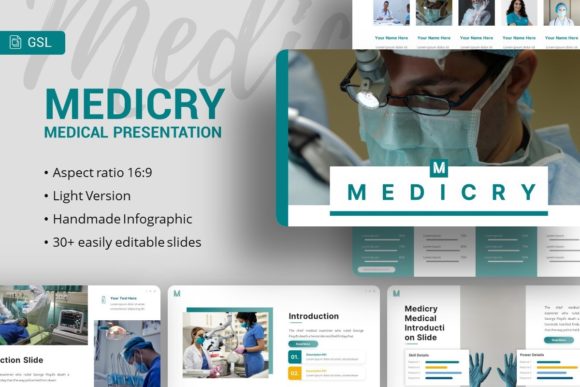
Furthermore, verify that you are working within the correct ecosystem. The template includes handcrafted infographics based on Master Slides. These are powerful for maintaining consistency but can be frustrating if you attempt to edit them as standard shapes. Users who do not understand Master Slide functionality often try to force-edit locked elements on individual slides, leading to broken layouts and wasted effort. Take ten minutes to review the included Documentation File. It explains how to unlock and modify these global elements correctly, preserving the pixel-perfect illustrations across all 35 slides.
The Reality of Image Placeholders and Licensing
Perhaps the most significant source of disappointment for new users is the assumption that demo images are included. It is vital to understand that all images in the Medicry preview are for demonstration purposes only and are not part of the downloadable files. Relying on these placeholder visuals for your final presentation is a critical error that can lead to copyright issues or a disjointed final product.
To maintain the high-quality look of the template, you must source your own imagery that matches the tone of the original design. Low-resolution or stylistically clashing photos will undermine the premium feel of the pixel-perfect illustrations. Plan your asset gathering phase before you start editing. Look for authentic, well-lit photography that complements the template’s color palette. Since the template features drag-and-drop picture placeholders, swapping images is technically simple, but finding the right replacement requires forethought. Budgeting time for image sourcing prevents the "generic stock photo" look that diminishes credibility in medical and corporate communications.
Customization Pitfalls and Brand Consistency
Medicry offers easy customizable contents, but ease of use does not guarantee good design. A frequent mistake is over-customization without a strategy. Users often change every color and font to match their brand instantly, disregarding the template's built-in hierarchy. The template was designed with specific contrast ratios and spacing to ensure readability. Drastically altering these parameters can reduce accessibility, which is particularly problematic in healthcare presentations where clarity is paramount.
Instead of a complete overhaul, adopt a selective customization approach. Utilize the resizable and editable graphic elements to integrate your branding subtly. For example, keep the infographic structures intact but adjust the accent colors to match your organization. Ensure that any vector icons you add from the included set maintain the same stroke weight and style as the existing assets. Mixing disparate icon styles creates visual noise that distracts from your data. Remember that the goal is to communicate information efficiently, not to showcase design manipulation skills.
Assessing Content Volume Against Slide Count
With 35 unique slides, Medicry provides ample room for comprehensive storytelling. However, having access to 35 slides does not mean you should use all of them. A common inefficiency occurs when presenters feel obligated to fill every available layout, resulting in bloated, unfocused presentations. In medical and business contexts, brevity often equates to competence.
Audit your content before selecting slides. Identify which of the 35 options genuinely serve your narrative arc. If you are creating a pitch deck, you might only need 10 to 12 slides. If you are delivering a training seminar, you might use 25. Delete unused slides early in the process to keep your workspace organized and your focus sharp. This also reduces file size and improves performance when presenting via screen share or cloud platforms. Quality of communication always trumps quantity of slides.
Making an Informed Decision
Before committing to the Google Slides Template - Medicry, conduct a brief audit of your specific needs. Confirm that your content justifies a medical or scientific aesthetic. Verify that you have the software knowledge to manage Master Slides or the willingness to learn via the documentation. Acknowledge that you must provide your own high-quality imagery. Finally, ensure that the 35-slide count aligns with your presentation goals rather than serving as arbitrary filler.
When used correctly, this template is a robust tool that elevates professional communication. It bridges the gap between technical medical information and modern presentation standards. By avoiding common pitfalls regarding compatibility, licensing, and design integrity, you can transform a standard template into a bespoke asset that enhances your credibility. Whether you are a freelancer building a portfolio, a startup founder pitching investors, or an educator teaching anatomy, success lies in respecting the tool’s intended function while adapting it thoughtfully to your unique context. Thoughtful preparation ensures that Medicry serves as a foundation for clarity rather than a source of frustration.