Evaluating the Google Slides Template - Seasons for Professional Presentations
Selecting the right presentation framework is a critical step in effective visual communication. For professionals and creatives seeking a versatile aesthetic, the Google Slides Template - Seasons offers a structured approach to slide design. While the name suggests a thematic focus on environmental or seasonal topics, the underlying architecture of this template supports a much broader range of applications. Understanding the specific features, customization capabilities, and practical limitations of this asset is essential for determining whether it aligns with your current project requirements and long-term presentation goals.
Defining the Asset and Its Core Utility
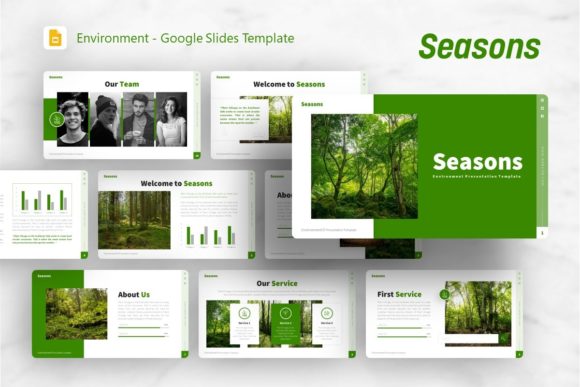
The Google Slides Template - Seasons is fundamentally a comprehensive design system rather than a single static file. It provides a pre-organized collection of 36 unique slides designed to streamline the creation process. Although marketed with imagery related to seasons and environmental introductions, the layout logic is agnostic, making it suitable for creative agencies, corporate profiles, business pitches, photography portfolios, and startup decks. The primary utility lies in its master slide structure, which allows for global changes across multiple slides, ensuring consistency without repetitive manual formatting.
Users should note that while the product title references Google Slides, the technical specifications indicate a PowerPoint (.PPTX) foundation. This distinction is vital for workflow planning. The template is built using handcrafted infographics and pixel-perfect illustrations that are fully resizable and editable within PowerPoint. While these files can be imported into Google Slides, users must evaluate whether their primary workspace is Microsoft Office or Google Workspace, as some advanced vector editing features may behave differently upon conversion.
Key Features and Customization Capabilities
When evaluating this template against others in the market, several technical features stand out as significant value drivers for non-designers and professionals alike:
- Master Slide Architecture: The template is based on master slides, meaning typography, color palettes, and logo placement can be adjusted globally. This reduces the time spent on individual slide maintenance and prevents formatting errors during last-minute edits.
- Editable Vector Infographics: Unlike templates that rely on flattened images for data visualization, this asset includes handcrafted infographics. These elements remain fully editable, allowing users to update charts, graphs, and diagrams with proprietary data without needing external graphic design software.
- Drag-and-Drop Media Placeholders: The inclusion of dedicated picture placeholders simplifies the integration of custom photography. This feature maintains aspect ratios and applies consistent masking, which is particularly beneficial for portfolio and agency presentations where visual alignment is paramount.
- Comprehensive Documentation: A documentation file is included, providing guidance on how to manipulate the master slides and utilize the vector icons effectively. This resource lowers the learning curve for users who may not be proficient in presentation software.
Strategic Fit: When to Choose This Template
The Google Slides Template - Seasons is most effective when the user’s needs intersect with its specific design philosophy. It serves as a strong fit for scenarios requiring a balance between organic aesthetics and professional structure. Creative agencies and personal portfolios often benefit from this duality, as the template provides enough visual warmth to distinguish a brand while maintaining the clean lines necessary for corporate credibility.
Furthermore, startups preparing pitch decks may find the 36-slide volume advantageous. Pitch decks often require specific narrative arcs involving problem statements, market analysis, team introductions, and financial projections. Having a diverse library of pre-formatted layouts allows founders to focus on content strategy rather than searching for appropriate slide types. The inclusion of vector icons also supports the rapid prototyping of concepts, enabling teams to visualize abstract ideas quickly during internal reviews or investor meetings.
For users specifically addressing environmental topics, sustainability reports, or climate initiatives, the template’s native aesthetic reduces cognitive load. The visual language already aligns with the subject matter, creating immediate thematic coherence. However, because the graphics are editable, the template remains viable for unrelated industries simply by adjusting the color scheme and replacing the illustrative elements.
Tradeoffs and Practical Considerations
No template is universally perfect, and objective evaluation requires acknowledging potential drawbacks. Prospective users must weigh the following considerations before adoption:
Software Compatibility and Workflow
As previously noted, the source file is .PPTX. Users committed exclusively to Google Slides must accept that importing the file may result in minor shifts in font rendering or object positioning. While generally functional, complex vector animations or specific gradient effects created in PowerPoint may not translate perfectly to the web-based platform. If your team collaborates strictly in real-time via Google Workspace, you should test the import fidelity before committing to this template for a high-stakes deliverable.
Asset Licensing and Image Rights
A common point of confusion in digital asset acquisition involves preview imagery. The documentation explicitly states that all images shown in the demo are for preview purposes only and are not included in the download. Users must budget time and resources for sourcing their own royalty-free or licensed photography. Relying on placeholder images indefinitely can undermine the professional polish the template is designed to provide. This separation of design and content is standard industry practice, but it requires proactive asset management.
Customization Depth vs. Speed
While the template is marketed as "easy customizable," achieving a truly unique look requires effort. Because the infographics are handcrafted vectors rather than simple shapes, modifying them demands a basic understanding of vector editing tools within PowerPoint. Users looking for a plug-and-play solution where they only change text may find the rich graphical elements overwhelming. Conversely, those willing to invest time in customization will achieve a higher-quality result than with simpler, more rigid templates.
Comparing Alternatives and Decision Framework
Determining whether the Google Slides Template - Seasons is the correct choice involves comparing it against available alternatives based on specific project parameters. If the primary requirement is strict corporate compliance with rigid brand guidelines, a minimalist template with fewer decorative elements might offer faster implementation. Highly stylized templates can sometimes conflict with established enterprise branding, necessitating extensive rework.
Alternatively, if the goal is pure data visualization or financial reporting, a template specialized in charts and tables may supersede this option. The Seasons template balances aesthetics and function, but it is not a dedicated data dashboard tool. Users whose presentations consist of 80% quantitative data should verify that the included infographic styles match their reporting density needs.
However, for generalist use cases where versatility is the priority, this template offers a favorable ratio of variety to cohesion. The 36-slide count provides sufficient breadth to handle mixed-content presentations without feeling repetitive. When making a final selection, users should audit their content outline against the available slide layouts. If at least 70% of the required slides have a direct counterpart in the template, the efficiency gains will likely justify the acquisition. If significant structural modification is needed for more than 30% of the deck, exploring alternative options may yield better productivity outcomes.
Final Evaluation for Implementation
The Google Slides Template - Seasons represents a robust middle-ground solution for presentation design. It avoids the sterility of basic corporate themes while steering clear of overly niche artistic constraints. Success with this asset depends largely on accurate expectation setting regarding software compatibility and image licensing. By leveraging the master slide functionality and editable vector components, users can create polished, professional narratives efficiently. Ultimately, the decision should rest on whether the template’s specific blend of organic design and structural flexibility supports the intended message and audience engagement goals.