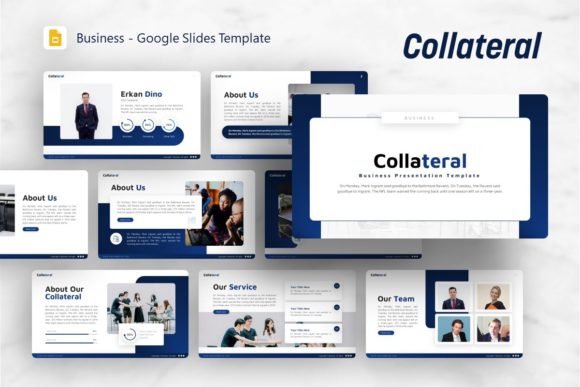
Google Slides Template - Collateral: Streamlining Professional Presentation Workflows
In the modern professional landscape, the speed at which you can communicate complex ideas is often just as important as the ideas themselves. Whether you are preparing a pitch deck for investors, updating a company profile for stakeholders, or showcasing a creative portfolio, the visual structure of your presentation dictates how your message is received. The Google Slides Template - Collateral serves as a foundational asset in this communication workflow, bridging the gap between raw data and compelling narrative. Rather than starting from a blank canvas, this template provides a pre-architected framework designed to reduce friction during the creation process while maintaining high standards of visual consistency.
For professionals aged 20 to 50, ranging from freelancers and educators to corporate executives and startup founders, time is a finite resource. The Collateral template is engineered to fit into existing productivity ecosystems, acting as a versatile container for various business and creative outputs. By leveraging a system based on master slides and handcrafted infographics, users can shift their focus from formatting alignment to strategic storytelling. This integration of design and function ensures that the tool supports the user's broader goals, whether that involves securing funding, educating an audience, or documenting a project lifecycle.
Strategic Application Across Project Phases
A common misconception about presentation templates is that they are merely aesthetic skins applied at the end of a project. In practice, the Google Slides Template - Collateral functions most effectively when integrated earlier in the planning and execution phases. Understanding where this asset fits within a project timeline allows for more efficient resource allocation and clearer communication milestones.
Pre-Project Planning and Pitching
Before a project receives approval or funding, clarity is paramount. During the ideation and proposal stages, the 36 included slides serve as a structural checklist. Instead of worrying about slide design, entrepreneurs and agency leads can use the template’s layout variety to organize their thoughts. The presence of specific infographic slides encourages users to visualize data relationships early on. If your pitch requires explaining a complex market analysis or a technical workflow, selecting a pre-designed diagram forces you to distill your concept into its essential components before you have even finalized the text. This acts as a cognitive scaffold, ensuring that the eventual presentation is logically sound and visually persuasive from the outset.
Active Project Management and Reporting
During the execution phase of a business workflow, communication needs shift from persuasion to information sharing. For project managers and team leads, the Collateral template offers consistent layouts for status updates, quarterly reviews, and internal briefings. Because the graphics are fully resizable and editable, teams can adapt the same visual language used in external pitches for internal documentation. This continuity reinforces brand identity and reduces the cognitive load on stakeholders who must regularly interpret project data. The drag-and-drop picture placeholders allow for rapid updates with current work samples or site photos, making weekly reporting a matter of content replacement rather than redesign.
Post-Project Portfolios and Case Studies
After a project concludes, the deliverables often need to be repackaged for future business development. Creative agencies, photographers, and consultants frequently use this template to build case studies. The portfolio-specific slides provide a structured method for displaying before-and-after scenarios, client testimonials, and final results. By maintaining a standardized format across multiple case studies, professionals can create a modular library of past work. This allows for the rapid assembly of customized proposals for prospective clients, where relevant past projects can be pulled into a new deck without requiring significant reformatting.
Integration with Broader Digital Ecosystems
No presentation exists in a vacuum. The utility of the Google Slides Template - Collateral is amplified by how well it interacts with other tools and assets in your digital stack. While the primary file is a PowerPoint .PPTX, its design philosophy aligns with cloud-based collaboration and cross-platform compatibility.
For users operating within the Google Workspace environment, uploading the .PPTX file converts it into a native Google Slides format. This transition preserves the master slide architecture, allowing teams to collaborate in real-time without breaking the design system. The vector icons and editable shapes remain functional, enabling adjustments directly in the browser. This interoperability is crucial for remote teams and hybrid work environments where version control and simultaneous editing are daily necessities.
Furthermore, the template interacts seamlessly with external asset libraries. Since the demo images are for preview purposes only, users must integrate their own photography and branding. The designated picture placeholders are sized to accommodate standard aspect ratios, reducing distortion when importing assets from stock libraries or internal media servers. For marketers and publishers, this means the template can act as a final assembly point for content generated in Adobe Creative Cloud, Canva, or AI image generators. The pixel-perfect illustrations provided in the file serve as a baseline quality benchmark, encouraging users to ensure their imported assets meet a similar standard of resolution and clarity.
Practical Implementation and Customization Workflow
To maximize efficiency, users should approach customization as a systematic process rather than an ad-hoc activity. The "easy customizable contents" feature relies heavily on the underlying Master Slide structure. Before adding specific content, it is advisable to audit the Master Slides to apply global changes such as logo placement, color palette updates, and font hierarchy adjustments. Making these changes at the root level propagates them across all 36 slides instantly, preventing the inconsistencies that often arise from manual, slide-by-slide editing.
When working with the handcrafted infographics, treat them as flexible frameworks rather than static images. Because they are built using native PowerPoint shapes, every element can be ungrouped, recolored, and resized. A practical workflow involves identifying the data story you need to tell first, then selecting the closest matching infographic, and finally modifying the shape labels and values to fit your specific metrics. This reverse-engineering approach ensures that the visual aids support the data, rather than forcing data into an inappropriate visual metaphor.
Organization is another critical factor in long-term usability. Users should rename slides and utilize section headers within the slide sorter view to categorize content. For example, separating "Team Bios," "Financial Projections," and "Service Offerings" into distinct sections allows for faster navigation during live presentations and easier duplication of relevant segments for future decks. The included documentation file serves as a technical reference for these organizational features, ensuring that new team members can adopt the template without extensive training.
Quality Control and Consistency Standards
Maintaining professional standards over time requires discipline. The Google Slides Template - Collateral provides the guardrails, but the user must enforce the rules. One of the primary risks in using any template is "scope creep," where users add custom elements that clash with the original design language. To prevent this, establish a style guide based on the template’s default settings. Define which fonts are permissible for body text versus headers and set strict guidelines for image treatment.
Consistency also extends to export and delivery formats. While the source file is editable, final deliverables should often be locked down to preserve formatting across different devices and operating systems. Testing the presentation in both edit mode and presentation mode is essential, as animations and transitions may behave differently depending on the platform. For personal portfolios or public-facing documents, exporting to PDF ensures that the pixel-perfect illustrations and typography render exactly as intended, regardless of whether the viewer has the original fonts installed.
Adapting to Diverse User Needs
The versatility of this template lies in its ability to serve distinct audiences through the same underlying structure. For a Startup, the focus may be on the pitch deck slides, utilizing bold typography and data visualization to demonstrate growth potential. For a Creative Agency, the emphasis shifts to full-bleed image layouts and minimalist text areas that let the work speak for itself. Educators might leverage the infographic slides to break down academic concepts, while Corporate users may prioritize the clean, grid-based layouts for annual reports.
Freelancers and solopreneurs benefit significantly from the reduction in administrative overhead. Without a dedicated design team, the ability to produce agency-quality collateral independently is a competitive advantage. The template effectively democratizes high-end design, allowing individuals to compete visually with larger organizations. However, this advantage is only realized if the user invests time in understanding the tool's capabilities. Reading the documentation and experimenting with the master slides during low-stakes practice sessions prepares users for high-pressure scenarios where technical fumbling is not an option.
Ultimately, the Google Slides Template - Collateral is a productivity multiplier. It removes the barrier of entry to professional design, allowing users to allocate their mental energy toward strategy, content creation, and relationship building. By treating the template as a dynamic component of your business workflow rather than a static product, you ensure that your presentations remain effective, consistent, and aligned with your evolving professional objectives. Whether used for a single pitch or as the backbone of a year-long communication strategy, this asset facilitates a smoother path from concept to delivery.