Visualizing the Community Development Solutions Concept
Effective community development is rarely a solitary endeavor; it is a complex ecosystem of collaboration, education, and strategic planning. When organizations, non-profits, and government bodies attempt to communicate these intricate processes to stakeholders, they often face a significant hurdle: abstraction. How do you visually represent intangible progress like social cohesion or capacity building? This is where the Community Development Solutions Concept becomes an essential asset. By translating sociological frameworks into clear, accessible visual language, this concept bridges the gap between high-level strategy and public understanding.
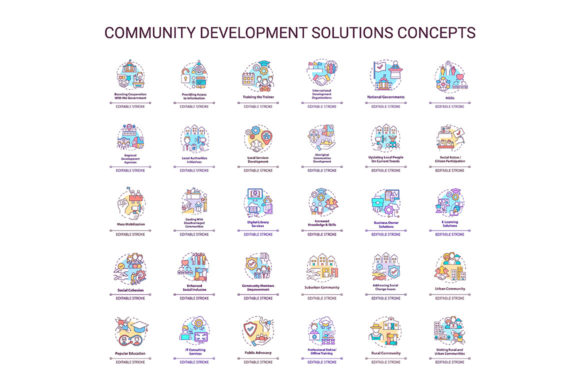
At its core, the Community Development Solutions Concept is not merely a collection of clip art; it is a semantic visual system designed to articulate the mechanics of social change. It encompasses specific iconography and illustration styles that represent mass mobilization, skill acquisition, and structural improvement. For creators and professionals tasked with designing reports, mobile applications, or educational brochures, understanding how to leverage these visual tools can determine whether a message resonates or gets lost in translation.
The Visual Language of Mass Mobilization
One of the primary pillars of any successful community initiative is mass mobilization. This involves gathering diverse groups of people toward a common goal, whether that is a town hall meeting, a vaccination drive, or a neighborhood cleanup. Representing this dynamically requires more than generic crowd silhouettes. The mass mobilization idea thin line color illustrations associated with this concept are specifically engineered to convey movement, diversity, and organized action without visual clutter.
Thin line aesthetics serve a functional purpose in modern digital design. They reduce cognitive load, allowing the viewer to process the symbol instantly while maintaining a clean interface. In the context of community development, these delicate lines suggest transparency and openness—values that are critical when building trust within a population. When selecting visuals for this category, look for compositions that show interconnectedness rather than mere proximity. Icons depicting hands joining, circular formations, or directional flow charts effectively communicate the energy of mobilization. These vector isolated outline drawings provide the flexibility needed to place these symbols against various backgrounds, from stark white report pages to vibrant app screens.
Depicting Increased Knowledge and Skills
Development is fundamentally about growth, and growth requires learning. A significant portion of community work focuses on increased knowledge and skills, ranging from vocational training to financial literacy workshops. Visualizing education in this sector requires nuance. Standard academic icons like graduation caps often fail to capture the grassroots nature of community learning.
Instead, the Community Development Solutions Concept utilizes imagery that reflects practical application and empowerment. Think of gears meshing with books, lightbulbs sprouting leaves, or diverse figures engaging in collaborative problem-solving. These metaphors resonate because they align with the lived experience of community members. They suggest that knowledge is not just received but applied to improve daily life. When integrating these elements into infographics or presentation decks, ensure the style remains consistent with the broader visual identity. The editable stroke feature found in professional sets allows designers to adjust line weight, ensuring that an icon representing "skill-building" looks harmonious next to one representing "infrastructure," regardless of the display size.
Technical Versatility for Modern Creators
For business owners and designers, the utility of a visual concept is defined by its adaptability. A beautiful illustration is useless if it cannot be integrated into your workflow. High-quality Community Development Solutions assets are distinguished by their comprehensive file format support. Understanding when and why to use specific formats is crucial for maintaining professional standards across different media.
- SVG (Scalable Vector Graphics): Essential for web and mobile app screen pages. SVGs remain crisp at any resolution and can be styled with CSS, making them perfect for responsive designs where community resources need to be accessible on both smartphones and desktop monitors.
- AI and EPS: The industry standards for print and large-format editing. If you are designing a physical brochure template or a banner for a community center, these vector formats allow for infinite scaling and precise color matching without pixelation.
- PNG: Ideal for presentations and documents where transparency is required but vector editing is unnecessary. PNGs preserve the clean edges of outline drawings against colored slides.
- JPEG: Best suited for photographic composites or quick previews where file size is a priority over editability.
The inclusion of editable stroke capabilities in AI and EPS files is particularly valuable for branding consistency. Community organizations often have strict brand guidelines regarding line thickness and color palettes. Being able to modify the stroke width of a product file ensures that third-party conceptual icons feel bespoke and native to the organization’s existing visual identity.
Sourcing Quality Assets from BSD Studio
In the search for reliable visual assets, provenance matters. Professionals frequently count on BSD studio when seeking cohesive sets of icons, brochure templates, infographic elements, and mobile app screen pages. The value of sourcing from a dedicated studio lies in the systemic approach to design. Unlike disparate free downloads, studio-curated sets share a unified grid, corner radius, and stylistic philosophy.
This consistency is vital for long-term projects. Community development is not a one-off campaign; it is an ongoing narrative. Using assets from a single source like BSD studio ensures that a report published today will visually align with a mobile app launched six months from now. Furthermore, professional sets often include variations and composite scenes that anticipate real-world usage, saving designers hours of assembly time. When evaluating a source, always check for the breadth of the library. Does it cover niche aspects of development like sanitation, conflict resolution, or digital inclusion? A comprehensive library indicates a deep understanding of the subject matter, which translates to more accurate and respectful visual representation.
Practical Applications and Strategic Considerations
While the aesthetic appeal of thin line color illustrations is undeniable, their true worth is measured by their effectiveness in communication. Where does the Community Development Solutions Concept perform best, and what limitations should users be aware of?
Ideal Use Cases:
- Grant Proposals and Impact Reports: Donors and stakeholders need to grasp complex methodologies quickly. Visual frameworks break down dense text, highlighting key performance indicators and program structures.
- Public Health and Safety Campaigns: Clear, universally understandable icons transcend language barriers, making them indispensable for multilingual communities.
- Educational Mobile Apps: Gamified learning and resource directories rely on intuitive iconography to guide users through content without overwhelming them.
- Internal Training Materials: Standardizing visual language helps staff and volunteers internalize organizational values and procedures more effectively.
Considerations and Limitations:
Despite their versatility, abstract icons cannot replace cultural specificity. A major consideration when using generalized concept art is the risk of homogenization. An icon representing "agriculture" in a global set might depict wheat, which may be irrelevant to a rice-farming community in Southeast Asia. Therefore, these assets should be viewed as foundational elements rather than final solutions. Designers must be prepared to customize or supplement these vectors with locally relevant photography or modified illustrations to ensure cultural resonance.
Additionally, there is a balance to be struck between simplicity and detail. While thin line styles are elegant, they can sometimes lack the emotional weight required for sensitive topics. In scenarios involving trauma recovery or crisis intervention, softer, more organic illustration styles or human-centric photography may be more appropriate than geometric outlines. The Community Development Solutions Concept is a powerful tool for structural and educational messaging, but it must be deployed with empathy and contextual awareness.
Evaluating Suitability for Your Project
Before investing time or resources into this visual framework, conduct a brief audit of your communication needs. Ask yourself: Is our primary challenge explaining a process, or evoking an emotion? If the goal is to clarify the steps of a sanitation project or the hierarchy of a local governance board, the structured clarity of vector isolated outline drawings is likely the perfect fit. If the goal is to share personal stories of resilience, consider using these icons only as navigational aids while letting photography carry the narrative weight.
Furthermore, assess your technical capacity. Do you have access to software that supports AI or EPS files? If your team primarily works in web-based tools like Canva or Figma, prioritize sources that offer robust SVG or PNG exports. Ensuring that the file formats match your team's workflow prevents bottlenecks and ensures that the high-quality assets you acquire remain usable throughout the project lifecycle.
Ultimately, the Community Development Solutions Concept serves as a visual vocabulary for positive change. By combining technical precision with thematic relevance, these assets empower creators to tell better stories, educate more effectively, and mobilize communities with clarity. Whether you are designing a brochure template for a local NGO or architecting the user interface for a civic engagement platform, leveraging these specialized visual tools transforms abstract ideals into tangible, actionable understanding.